


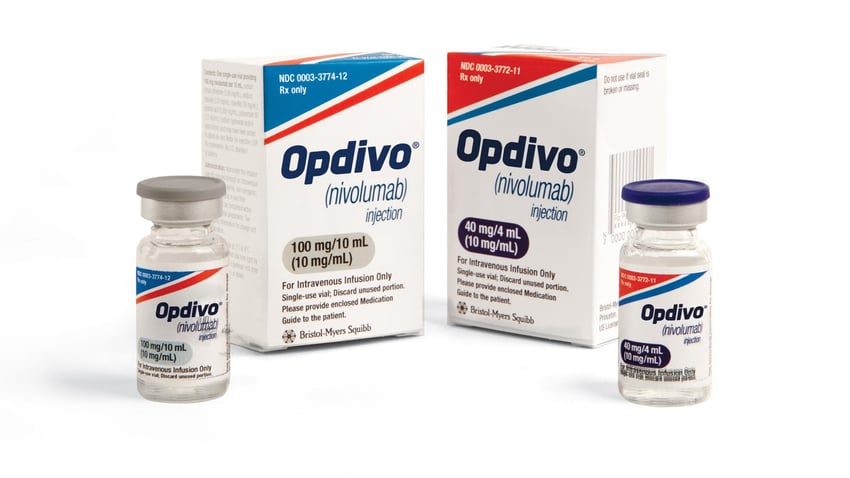
In a dramatic seesaw effect today, Bristol-Myers Squibb ($BMY) watched its share price plunge 20% while competitor Merck & Co.'s ($MRK) soared 10% after BMS said its cancer wonder drug Opdivo had failed to meet goals for use as a first-line treatment for lung cancer.
Opdivo and Merck’s Keytruda have been battling for market share in a variety of cancer forms, but the first-line use in lung cancer, which kills more people in the U.S. than any other cancer, is seen as very important for the immuno-oncology drugs, with the possibility of adding billions of dollars in annual sales. It is seen as so important by investors that the news swept away nearly $25 billion in market value for New York-based BMS in premarket trading before pressure on its shares eased.
Bristol-Myers tried to make the best of a bad situation by immediately hustling out a statement about how proud it was of Opdivo. It pointed out that while it missed its endpoints for a broad population in lung cancer in a late-phase trial, it is also being tested along with its drug Yervoy for PD-L1 positive patients and with Yervoy or chemo for PD-L1 negative patients.
“We believe that combination therapy may provide an important opportunity to address the needs of every patient with first-line lung cancer,” the company said.
Merck was mum, but the markets spoke for it. When trading opened, its share price came out up more than 6% and climbing. Merck is now in the catbird seat for the highly valued indication. In June it reported that its PD-1 checkpoint inhibitor Keytruda met its goals in a new trial in previously untreated non-small cell lung cancer (NSCLC) patients, beating chemotherapy at holding off advance of the cancer and extending patients’ lives.
In that study Keytruda was tested as a standalone treatment, rather than as part of a combination of meds. Patients in the trial had advanced NSCLC, and their tumors tested positive for PD-L1 levels of 50% or more. It met both the trial’s primary endpoint of progression-free survival and its secondary endpoint of overall survival.
Bernstein Analyst Tim Anderson agreed with Bristol-Myers that it may be in combo drugs where the real fortunes are made. He said that the result of the trial “likely reflects the fact that BMY pushed the envelope too far in designing its trial.”
He said the unexpected news, was hurtful to Opdivo and helpful to rival Keytruda. “The companies have been locked in a marketing battle in lung cancer, which is likely a $10 billion to $15 billion opportunity, with BMY dominating thus far by a wide margin,” Anderson wrote in a note to clients. “Today’s news very much helps level the playing field and is a major boost for MRK.”
He said a further analysis of the results may actually show that Opdivo, with its broader effort, actually performed similarly to Keytruda. Still, Anderson said, “this does not erase the fact that BMY’s trial is a miss and major upset. It puts BMY on its back foot from a commercial perspective, as it tries to defend its franchise.”
Before today’s announcement, Opdivo was seen as leading Keytruda in treating lung cancer. Keytruda and Opdivo are both approved as second-line treatments, but Opdivo doesn’t require PD-L1 testing and Keytruda does.
Both drugs are selling well with huge expectations for the future. Anderson today pegged the value of the lung cancer market for the drugs, alone or in combos, at between $10 billion and $15 billion and said with today's results, it is possible $1 billion of those sales will now change hands.
- here’s the statement
Related Articles:
Bristol's Opdivo-Yervoy combo ups response rates in first-line lung cancer patients
Merck's Keytruda tops chemo in first-line lung cancer trial
Merck's Keytruda held back by docs who don't want to wait for diagnostics